
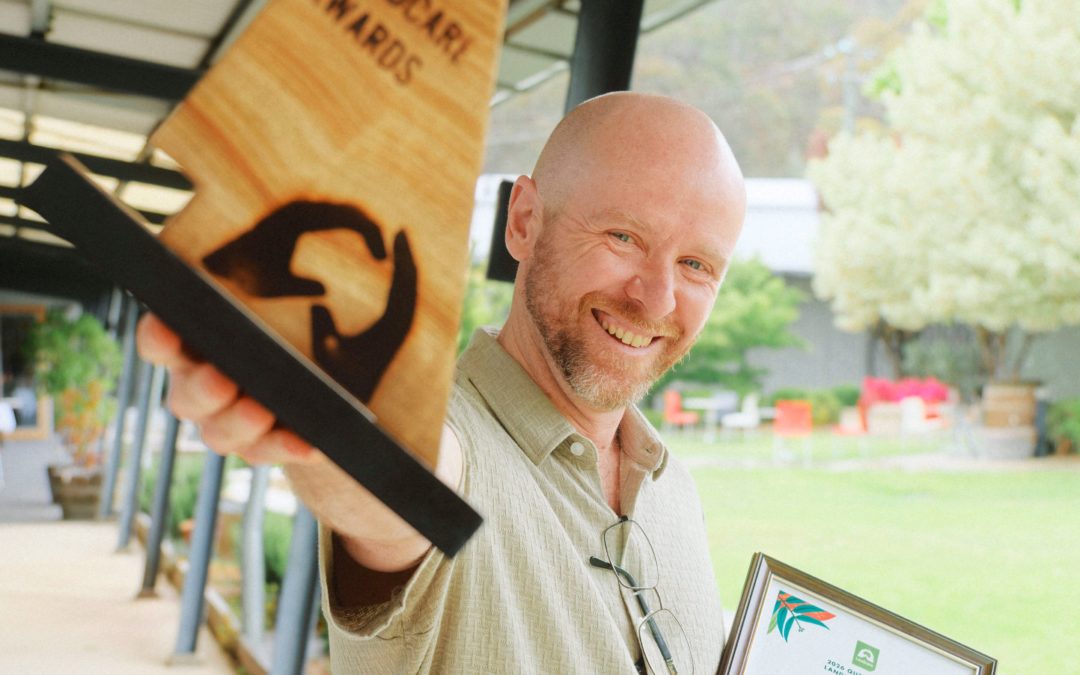
When the former owner of Messines Farm returned for a visit, Kieran Richardt had something to show him beneath the apple and apricot trees: earthworms.
The older man said he had not seen them there since childhood. For Kieran, who had been mulching the orchard, it was an encouraging moment in a job still far from finished.
That ongoing work has earned him the Queensland 2026 Australian Government Sustainable Agriculture Landcare Award, announced on 10 October at the Queensland Landcare Awards. Granite Borders Landcare Inc. hosted the Stanthorpe celebration.
Speaking at the Stanthorpe celebration, Member for Southern Downs James Lister highlighted the importance of local knowledge and community effort.
“Without the people doing the work on the ground, with the local knowledge and the local drive to enhance and preserve their environment, this sort of stuff wouldn’t happen,” Mr Lister said.
Queensland Water and Land Carers (QWaLC) works with Landcare Australia on the State Landcare Awards, helping bring the efforts of landholders, volunteers and community groups to wider attention. Kieran’s story shows why that recognition matters beyond the presentation: he wants others to learn from what happens on his farm.
“I want to show other people the things that we’ve had wins on and the things that we’ve made mistakes on,” he said.
From teaching to doing
Messines Farm is at Amiens on the Granite Belt. Kieran and his family bought the established orchard in 2020, taking on heirloom apples, pears, plums and apricots and a property with little infrastructure.
Early picking seasons meant sleeping in a swag, harvesting into trailers and taking fruit to the Gold Coast to sell. Making the farm viable brought a steep learning curve.
Kieran was already an environmental scientist and director of Natura Pacific, an environmental consulting and education social enterprise. The farm gave him somewhere to put the ideas he had been teaching into practice.
His interest in living things began much earlier.
“I was always bringing stray critters home and trying to grow all sorts of plants at home,” he said.
That curiosity now extends from the orchard to the bushland in the middle of the farm.
An orchard with room for wildlife
About one third of the property is retained as native bushland. Alongside it, flowering groundcovers, native and solitary bee nesting habitat, and work along the creek are part of Kieran’s efforts to support wildlife throughout the farm.
“We use biodiversity to our advantage,” he said.
He wants pollinators and beneficial insects moving through the orchard and market garden. Mulch, compost and managed sheep grazing are among the methods the family uses while working to improve soil condition.
Spreading mulch takes time. Animals pull it out of place. Kieran keeps weighing up how each approach fits the farm’s water and labour constraints.
The earthworms were a welcome observation, but he is open about how much work remains.
Lessons worth sharing
Videos, screenings and the Messy: Regenerative Agriculture documentary series share the farm’s experience, including experiments that have not worked.
Kieran is also developing opportunities for visits, workshops and professional learning. He wants people to bring their own experiences to the farm, as well as see what his family is doing.
That exchange of practical knowledge connects his story with the community Landcare movement QWaLC supports. As Queensland’s peak body for natural resource management volunteers, QWaLC supports community groups whose work depends on people sharing skills, local knowledge and the effort of caring for a place.
The awards give those stories a statewide audience. For Kieran, that is a chance to encourage another landholder to try an idea, ask a question or learn from a mistake already made.
The people who make it possible
Kieran credits his wife and children, the Natura Pacific team, neighbours and the family who previously owned the orchard.
The former owners shared their knowledge of the orchard. Neighbours have offered advice and help. Kieran says the work could not happen without them.
“It’s definitely been a team effort,” he said.
He wants the soil, water and habitat in good condition for the next generation.
“If I can achieve that and pass something on to my kids that is in a good position to continue going forward in the future, then I’ll be a happy man,” he said.
Find out more about Messines Farm and its documentaries at messinesfarm.com.au. Explore the Queensland Landcare Awards and connect with community Landcare through qwalc.org.au.